
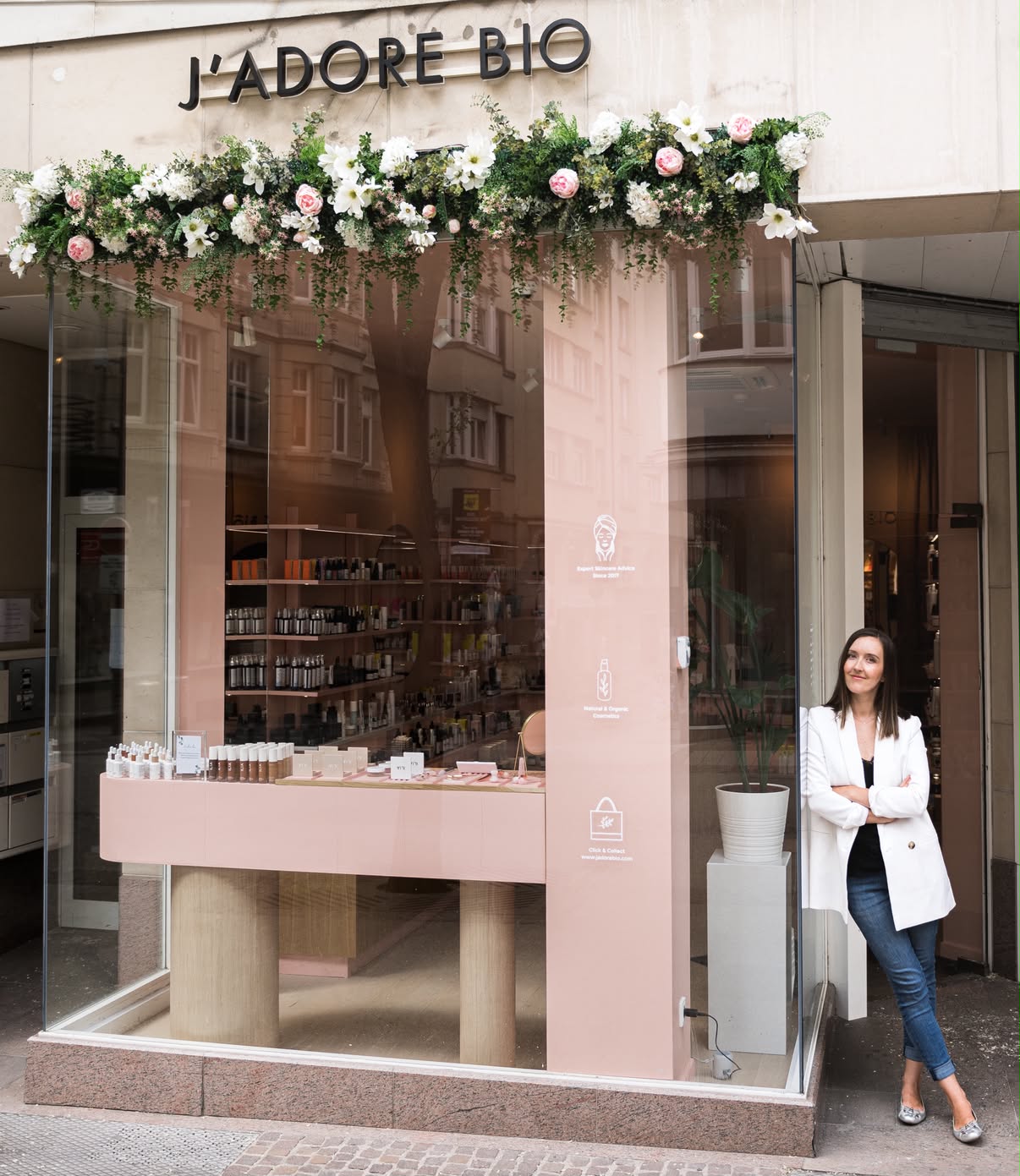
Finding your voice: Aga Halgas of J’adore bio on finding clarity as your brand evolves
The most interesting people — and brands — have a voice that is undeniably their own.
But how do you actually find that voice and learn to trust it?
That’s the question behind Finding Your Voice, our new interview series exploring the stories of female founders who have carved out their own way of doing business — and who can inspire us to do the same as we shape our own brands.
First up is Agnieszka “Aga” Halgas, founder of J’adore bio, a clean beauty shop in the heart of Luxembourg City that has built something of a cult-like following over the past nine years.
Originally from Poland, Aga studied in London before she and her husband chose Luxembourg as the place they wanted to call home. While she was working as a financial consultant, a personal interest in wellness sent her down a research rabbit hole that eventually uncovered a business opportunity.
What started as an online side hustle run from her apartment has since grown into a beloved Luxembourg business with more than 50 carefully selected beauty brands, a brick-and-mortar store in the heart of the city, and plans for a second location.
We sat down with Aga to talk about spotting the gap that started it all, how she lets her customers shape the brand, balancing intuition with analysis, learning to say no, and why finding your voice is only half the battle.
This interview has been edited for clarity and flow.

What first sparked the idea for J’adore bio?
My husband and I started doing research, reading books, and watching documentaries. We both made a conscious shift in our lifestyle choices — around food, clothing, and then also beauty.
Beauty was a really big aha! moment for me. I became really interested in it, and then I realized I didn’t have a shop in Luxembourg where I could buy my beauty products.
It was a very clear gap in the market.
There was no shop with really nice, pleasant-to-use products. I saw my friends who were happy with their aesthetically pleasing products, and I didn’t feel that same enthusiasm during my skincare routine. I wanted that too.
At what point did you think, “Okay, I actually want to make this a business”?
Immediately. I come from a family of entrepreneurs, so I always knew I wanted to have my own business. I just didn’t know what it would be. It immediately clicked when I found this gap. I was like, “Okay, let’s do this.”
Because of my financial background, I immediately went into: “Okay, let’s do a business case.”
What did the early days of J’adore bio look like?
At the beginning, it was just an online shop because I couldn’t afford not to work full-time while starting this.
J’adore bio was my passion project. When I was home, I would build the website, work on content, try new brands, do research, and pack orders — and then ship them the next day before going to work.

At what point did it stop feeling like a side hustle and start feeling like it could become your full-time thing?
At the beginning, I wanted to be an online shop shipping across Europe with a very curated selection of clean beauty. But then I had a reality check. Most of our clients were local. They wanted pop-ups, markets, and to see and try the products. People here really like the human connection. You have to build that trust.
So we opened a small shop, but that still wasn’t really the breakthrough moment where I thought, “Okay, now I can quit my job.”
COVID was that moment for J’adore. Our sales really boomed. I think because people were suddenly more conscious about their choices. People realized that they weren't immortal, so maybe they should think about their health. By summer 2020, I quit my job.
In the beginning, how much of you and your personal taste was in the brand?
At the very beginning, it was a one-woman show. I was the brand. If I liked something, I said yes. But business is like a living organism. When it’s small, it’s also linked to you and to your phases of life.
I went through a zero-waste phase, for example, and J’adore Bio became a little more “hippie.” We sold soaps for everything and products in bulk.
Now that we have a team, I don’t want J’adore Bio to be a one-woman show anymore. I want other people’s opinions. Brand selection is still 100% me, but I really value the opinions of the women I work with. It’s much more of a team effort now.
How do you decide what feels right for J’adore bio today?
Everything I do, I have this imaginary client that I always picture. Whether it’s copy for social media, the design and decor of the shop, a new brand, or a marketing decision, I filter it through the lens of this client.
At the beginning, I was that client. That’s probably why things were a little more chaotic, because I was evolving a lot myself. Then I started meeting our real customers. Over time, I built this idea of who the J’adore bio customer is from small pieces of different people, conversations I overheard in the shop, and all those interactions.
Now I have a very clear picture.
If somebody on the team shows me a banner, a window display, or a piece of copy, I can immediately think, “No, our client wouldn’t be interested in this. We need to change it.”
Has it become easier to know what to say no to?
Yes. Thanks to our product selection criteria, a lot of brands don’t pass, so then it’s a very easy no.
When we present a brand to our clients, I sign under it. Clients trust us a lot, and it took me nine years to build this trust. With some trendy brand or whatever, I don’t want to lose it.
We were actually quite far into developing a J’adore bio skincare range. I was physically in a laboratory working on it. But then my intuition said, “I don’t think that’s a good idea.”
Everyone was pushing me to do it, but I thought, “This doesn’t feel right."
I don’t think our clients need another brand just so that I would stick my logo on it. I'm not a chemist, and I knew that I didn't have the specific skills to formulate something super innovative.
So we didn’t do it.
You mentioned listening to your intuition. I'm curious: how do you balance that with your analytical side?
I’ve had plenty of ideas that felt really good to me, but practically, they just weren’t possible. For years, for example, customers have asked us to open a spa using the products we carry. I love the idea. I see the potential. I want to do it. But practically, with the regulations and administration involved, it just isn’t possible for us right now.
After almost ten years with J’adore Bio, I’ve experienced a lot. I know much better now when something is a good idea and when it’s a bad idea. I also have much more to lose from making a bad decision than I did before. I’m responsible for a team now.
Five years ago, there are probably opportunities I would have said yes to without thinking twice. Now, I think and analyze much more.
Is there anything that you thought as a business you should do that looking back now you would approach differently?
Last year, I invested quite a lot in paid advertising because it felt like everybody was doing it. We had always grown our social media very organically, but I thought, “We’re bigger now. Maybe we should allocate a marketing budget to paid ads.”
We did it properly. We hired an agency, gave it 12 months, and invested in it. But in the end, it wasn’t a great decision for us. However, I would do it again, because otherwise I would always be wondering, “What if?”
I think that’s true of a lot of bad decisions in business. With all of the mistakes I’ve made, I would do them again. At the end of the day, running a business is solving a new problem every day.
And how do you handle it when something fails?
I don’t take it personally. I just say, “Okay, this doesn’t work. Let’s try something else.” It’s very quick for me.
Is there anything you’ve had to unlearn as a founder?
I had to unlearn being polite in all circumstances; how to say no and be okay with being uncomfortable. As a founder, I learned with experience that not every relationship, not every collaboration, not everything will always be super pleasant.
And I don’t have to make things right in every situation. That was maybe the most difficult lesson for me.
What does “finding your voice” in business mean to you?
I feel like, as an entrepreneur, you must have already found your voice in order to even start.
I think that’s what differentiates entrepreneurs. They found their voice, and they want to share it with the world. But what’s maybe much more difficult is to be confident enough to use your voice.
That, I think, you only learn as you go — with the mistakes you make, with failures, and with experience.

Allowing the space for evolution
Aga's story is a testament to what can happen when you give your idea the space to evolve while sticking close the values and vision that drove you to get into business in the first place.
As you get to know your customers and test ideas, that experience builds the confidence and clarity to know what direction to take next.
___
A big thanks to Aga for sharing her voice and story with us!
Know a female founder who would be a great fit for this series? We'd love to meet them! Email us here.


.png)
Find your brand voice, attract your people
download the guide